Tell us about the job
Takes about a minute. No obligation.
Sizing a central AC system in Oneida County rewards precision over guesswork. Homes in Oneida County, ID run cooling about two months a year, from July through August. The compressor, contactor, and condenser fan carry the full load of every cooling cycle in that window, and an undersized system runs harder to compensate, stressing those components each time it starts and stops. A contractor who skips the load calculation and guesses at tonnage is likely to leave a homeowner with a unit that cycles too frequently, wearing the contactor faster than the equipment schedule assumes. Getting the refrigerant charge and airflow balanced at commissioning matters for the same reason.
Ductwork laid down for an older system carries assumptions about airflow, routing, and capacity that a new central AC unit does not share. Half the homes in Oneida County, Idaho were built in 1971 or earlier (2020-2024 ACS 5-year). That depth of housing stock means a contractor opening walls in this county is regularly working out whether what is already there can move the air a current system requires, or whether the duct runs have to be corrected before the new unit goes in. The electrical question follows the same logic: service configured for an earlier load may need attention before a modern compressor can run on it. What the house already contains is what the installation price turns on.
What a Central AC System Is Made Of
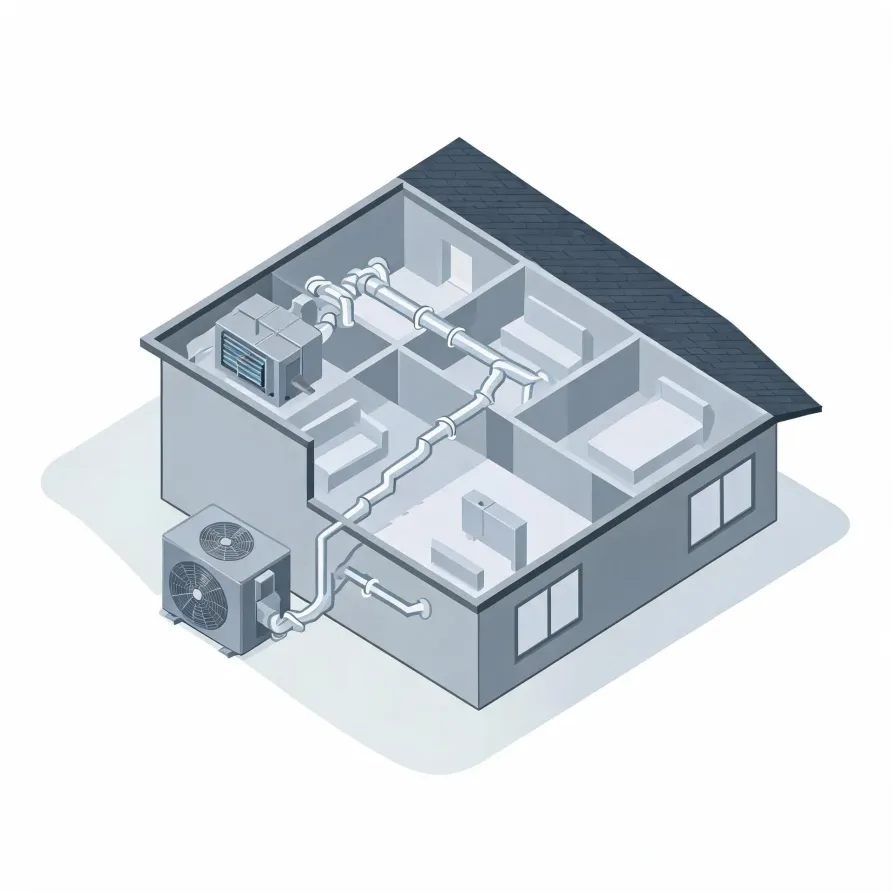
The outdoor unit sits on a pad beside the house and holds the compressor and condenser coil. Inside, the air handler or furnace cabinet mounts in a mechanical room, basement, or closet and holds the evaporator coil, which is the piece that does the cooling work at that end of the system.
A refrigerant line set runs between the two units, carrying refrigerant back and forth through copper tubing wrapped in insulation. A thermostat on an interior wall ties the whole system together, reading the temperature in the house and telling the equipment when to run.
The drawing shows the general layout of a central AC system, and a licensed contractor determines exactly how each piece fits the conditions in your house.
Find a contractor in Oneida CountyOneida County, by the numbers
78 severe weather events were recorded in Oneida County, Idaho between 2015 and 2024.
NOAA National Centers for Environmental Information, Storm Events Database, bulk CSV export, events 2015-01-01 through 2024-12-31.Half the homes in Oneida County, Idaho were built in 1971 or earlier (2020-2024 ACS 5-year).
U.S. Census Bureau, 2020-2024 American Community Survey 5-Year EstimatesOneida County, Idaho holds 2,101 housing units (2020-2024 ACS 5-year).
U.S. Census Bureau, 2020-2024 American Community Survey 5-Year EstimatesOwners occupy 88.3% of the occupied homes in Oneida County, Idaho (2020-2024 ACS 5-year).
U.S. Census Bureau, 2020-2024 American Community Survey 5-Year EstimatesCodes & Standards Governing Central AC Installation in Oneida County, Idaho9 sourced rules and standards
What Happens During an AC Installation in Oneida County
Split-system central air conditioners rated below 45,000 Btu/h manufactured on or after January 1, 2023 must meet a federal minimum of 13.4 SEER2.
Split-system central air conditioners rated at or above 45,000 Btu/h manufactured on or after January 1, 2023 must meet a federal minimum of 13.4 SEER2.
Split-system central air conditioners manufactured between January 1, 2015 and December 31, 2022 had to meet 13 SEER, the metric that preceded SEER2.
Single-package central air conditioners manufactured on or after January 1, 2023 must meet a federal minimum of 13.4 SEER2.
Space-constrained central air conditioners manufactured on or after January 1, 2023 must meet a federal minimum of 11.7 SEER2.
Federal efficiency standards for split-system central air conditioners and heat pumps are set on each certified combination of outdoor unit and indoor coil rather than on the outdoor unit alone.
Residential and light commercial air conditioning and heat pump systems assembled in the field, including mini-splits and unitary systems, may not be installed on or after January 1, 2025 using a refrigerant with a global warming potential above 700.
A field-assembled system whose specified components were all manufactured or imported before January 1, 2025 carries no installation compliance date under the refrigerant restrictions and may still be installed.
Licensing Rules for HVAC Work in Oneida County, Idaho
Idaho requires a state certificate of competency for heating, ventilation and air conditioning work: it is unlawful to engage in the business, trade or practice without passing the examination and holding the certificate.
Severe Weather Events in Oneida County
Weather puts a measurable load on any cooling system, and that load shapes what equipment is right for a given location. An AC installation sized and specified for local conditions runs more reliably and lasts longer than one that ignores them.
78 severe weather events, 2015–2024. Source: NOAA National Centers for Environmental Information, Storm Events Database.