Tell us about the job
Takes about a minute. No obligation.
A short cooling season concentrates every start cycle, every refrigerant pressure spike, and every hour of condenser fan runtime into a tight window. Homes in Washington County, ID run cooling about two months a year, from July through August. The compressor takes the hardest part of that load, cycling on and off repeatedly through July and August heat with little calendar spread to soften the cumulative stress. When a unit fails, a contractor checks the compressor windings, the contactor contacts, and the capacitor before anything else, because those are the components that absorb each start. A system that was undersized or low on refrigerant entering the season arrives at that inspection with accelerated damage already done.
Central AC systems in older housing stock get repaired against whatever the opened unit actually contains, and in Washington County the housing tells you something about how narrow that search can run. Half the homes in Washington County, Idaho were built in 1975 or earlier (2020-2024 ACS 5-year). A system installed into a house of that vintage may have been replaced once or twice since, but the one running now was chosen to fit what the house already had, and that lineage shapes the parts a contractor needs. When a unit comes apart and the failed component traces back to a line no longer manufactured, the job changes scope before a quote is possible.
The Parts of a Central AC a Contractor Checks During a Repair
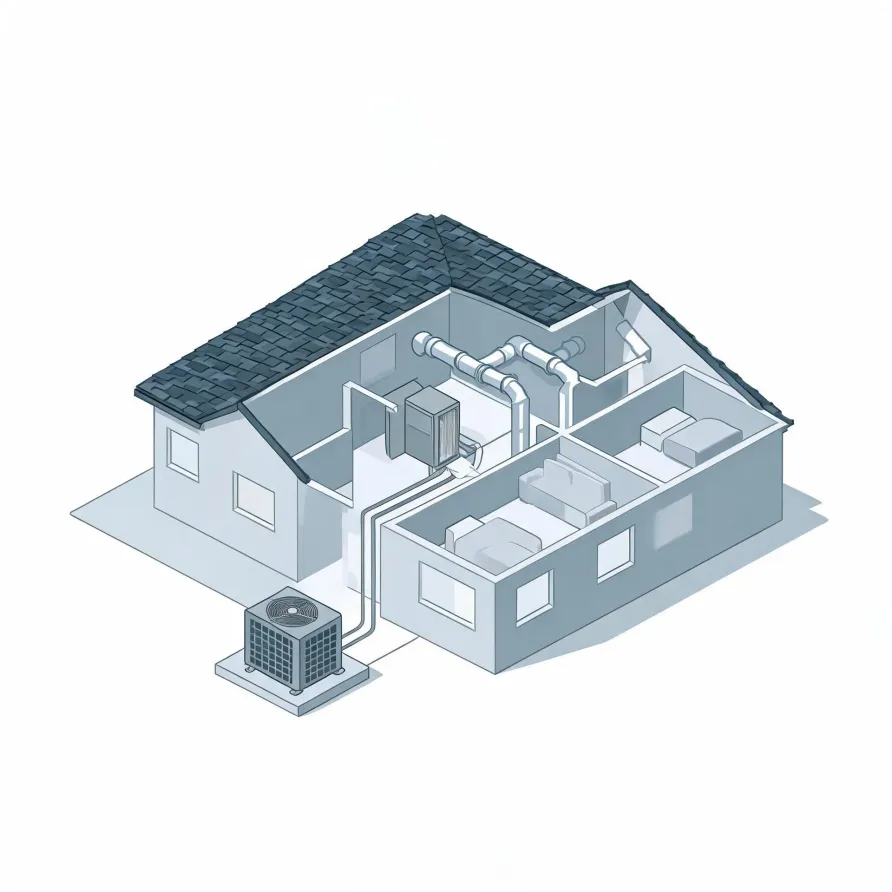
The outdoor condenser unit sits outside the house, usually beside or behind it, and holds the compressor and condenser coil. These are the pieces a contractor reaches first when something has stopped working, because a failed compressor or a damaged coil will shut the whole system down. The air handler or furnace cabinet inside the house holds the evaporator coil and the blower, and a fault in either one shows up as warm air, weak airflow, or ice forming where it should not.
The refrigerant lines run between the outdoor and indoor units, carrying the charge that lets the system move heat. A contractor checks these for leaks when the system is underperforming but the mechanical parts appear sound. The expansion valve and the condensate drain line sit at the indoor cabinet as well, and both are common sources of trouble that do not announce themselves loudly.
The drawing shows a typical layout, and a licensed contractor determines which parts apply and what the repair requires in your specific home.
Find a contractor in Washington CountyWashington County, Idaho, by the numbers
100 severe weather events were recorded in Washington County, Idaho between 2015 and 2024.
NOAA National Centers for Environmental Information, Storm Events Database, bulk CSV export, events 2015-01-01 through 2024-12-31.Half the homes in Washington County, Idaho were built in 1975 or earlier (2020-2024 ACS 5-year).
U.S. Census Bureau, 2020-2024 American Community Survey 5-Year EstimatesWashington County, Idaho holds 4,629 housing units (2020-2024 ACS 5-year).
U.S. Census Bureau, 2020-2024 American Community Survey 5-Year EstimatesOwners occupy 74.6% of the occupied homes in Washington County, Idaho (2020-2024 ACS 5-year).
U.S. Census Bureau, 2020-2024 American Community Survey 5-Year EstimatesCodes & Standards Covering Central AC Repair in Washington County, Idaho9 sourced rules and standards
What HVAC Repair Looks Like in Washington County
Split-system central air conditioners rated below 45,000 Btu/h manufactured on or after January 1, 2023 must meet a federal minimum of 13.4 SEER2.
Split-system central air conditioners rated at or above 45,000 Btu/h manufactured on or after January 1, 2023 must meet a federal minimum of 13.4 SEER2.
Split-system central air conditioners manufactured between January 1, 2015 and December 31, 2022 had to meet 13 SEER, the metric that preceded SEER2.
Single-package central air conditioners manufactured on or after January 1, 2023 must meet a federal minimum of 13.4 SEER2.
Space-constrained central air conditioners manufactured on or after January 1, 2023 must meet a federal minimum of 11.7 SEER2.
Federal efficiency standards for split-system central air conditioners and heat pumps are set on each certified combination of outdoor unit and indoor coil rather than on the outdoor unit alone.
Residential and light commercial air conditioning and heat pump systems assembled in the field, including mini-splits and unitary systems, may not be installed on or after January 1, 2025 using a refrigerant with a global warming potential above 700.
A field-assembled system whose specified components were all manufactured or imported before January 1, 2025 carries no installation compliance date under the refrigerant restrictions and may still be installed.
Licensing Rules for Washington County, Idaho
Idaho requires a state certificate of competency for heating, ventilation and air conditioning work: it is unlawful to engage in the business, trade or practice without passing the examination and holding the certificate.
Severe Weather Events in Washington County
Extreme weather puts real stress on AC equipment, and how hard a system works over its life is a local question. Repair needs in Washington County reflect what the climate here actually asks of the hardware.
100 severe weather events, 2015–2024. Source: NOAA National Centers for Environmental Information, Storm Events Database.