Tell us about the job
Takes about a minute. No obligation.
Compressors that sit idle for most of the year fail in a different pattern than ones that run hard through long summers. Contactors corrode. Capacitors lose charge. Homes in Lincoln County, ID run cooling about two months a year, from July through August. A contractor diagnosing a refrigerant problem or a compressor that will not start here checks those dormancy-related parts before assuming the unit simply wore out from use, because the load history does not support that conclusion.
Stock built for one generation of cooling equipment accumulates a specific repair problem over time: the parts a system takes get harder to source as manufacturers redesign components around newer refrigerants and smaller tolerances. Half the homes in Lincoln County, Idaho were built in 1985 or earlier (2020-2024 ACS 5-year). A contractor who opens a central AC unit in a house from that era of the housing stock is less often diagnosing a straightforward failure and more often working out whether a replacement part still exists, or whether the repair scope has to change because it does not.
The Parts of a Central AC a Contractor Checks First
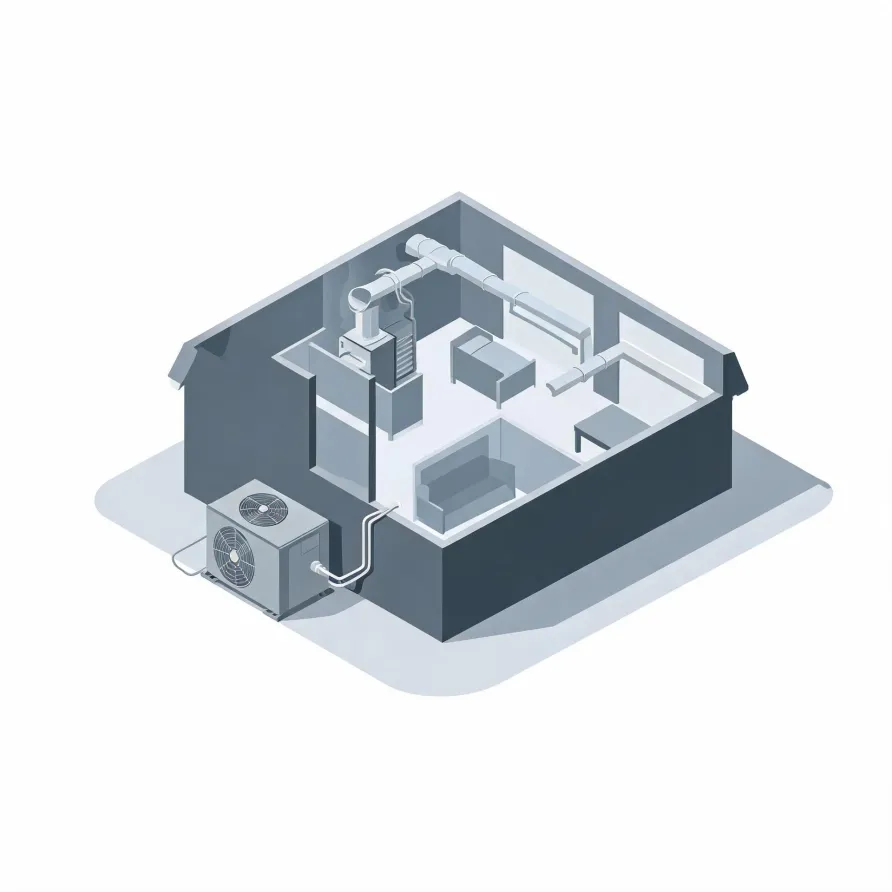
The outdoor condenser unit sits outside the house, usually on a concrete pad alongside the foundation, and it is where heat gets released to the outside air. The compressor lives inside that cabinet and is often the first thing a contractor tests when the system blows warm. The indoor air handler or furnace-mounted evaporator coil sits inside, typically in a utility space or attic, and pulls heat out of the air moving through your home.
The refrigerant lines run between the indoor and outdoor units, carrying the working fluid that makes the exchange possible, and a leak anywhere along them will leave both units running but doing nothing useful. The thermostat on the wall is the system's control signal, and a fault there can look exactly like a failed component deeper in the system.
The drawing shows a general layout of how these pieces relate to one another, and a licensed contractor determines what applies to the specific equipment and configuration in your house.
Find a contractor in Lincoln CountyLincoln County, Idaho, by the numbers
29 severe weather events were recorded in Lincoln County, Idaho between 2015 and 2024.
NOAA National Centers for Environmental Information, Storm Events Database, bulk CSV export, events 2015-01-01 through 2024-12-31.Half the homes in Lincoln County, Idaho were built in 1985 or earlier (2020-2024 ACS 5-year).
U.S. Census Bureau, 2020-2024 American Community Survey 5-Year EstimatesLincoln County, Idaho holds 1,989 housing units (2020-2024 ACS 5-year).
U.S. Census Bureau, 2020-2024 American Community Survey 5-Year EstimatesOwners occupy 78.9% of the occupied homes in Lincoln County, Idaho (2020-2024 ACS 5-year).
U.S. Census Bureau, 2020-2024 American Community Survey 5-Year EstimatesCodes & Standards Governing Central AC Repair in Lincoln County, Idaho9 sourced rules and standards
What HVAC Repair Looks Like in Lincoln County
Split-system central air conditioners rated below 45,000 Btu/h manufactured on or after January 1, 2023 must meet a federal minimum of 13.4 SEER2.
Split-system central air conditioners rated at or above 45,000 Btu/h manufactured on or after January 1, 2023 must meet a federal minimum of 13.4 SEER2.
Split-system central air conditioners manufactured between January 1, 2015 and December 31, 2022 had to meet 13 SEER, the metric that preceded SEER2.
Single-package central air conditioners manufactured on or after January 1, 2023 must meet a federal minimum of 13.4 SEER2.
Space-constrained central air conditioners manufactured on or after January 1, 2023 must meet a federal minimum of 11.7 SEER2.
Federal efficiency standards for split-system central air conditioners and heat pumps are set on each certified combination of outdoor unit and indoor coil rather than on the outdoor unit alone.
Residential and light commercial air conditioning and heat pump systems assembled in the field, including mini-splits and unitary systems, may not be installed on or after January 1, 2025 using a refrigerant with a global warming potential above 700.
A field-assembled system whose specified components were all manufactured or imported before January 1, 2025 carries no installation compliance date under the refrigerant restrictions and may still be installed.
Licensing Rules in Lincoln County, Idaho
Idaho requires a state certificate of competency for heating, ventilation and air conditioning work: it is unlawful to engage in the business, trade or practice without passing the examination and holding the certificate.
Severe Weather Events in Lincoln County
Weather puts a measurable load on AC equipment. The harder a system works to handle what the climate delivers, the more stress it carries over time, and that stress shows up as repair needs.
29 severe weather events, 2016–2024. Source: NOAA National Centers for Environmental Information, Storm Events Database.